Cyborg AI Minds are a true concept-based artificial intelligence with natural language understanding, simple at first and lacking robot embodiment, and expandable all the way to human-level intelligence and beyond. Privacy policy: Third parties advertising here may place and read cookies on your browser; and may use web beacons to collect information as a result of ads displayed here.

Sunday, April 30, 2023

VisRecog

This TikTok video thumbnail photo shows the AGI Mind coder Arthur Murray, known on the Internet as Mentifex (Latin for Mindmaker), serving in the U.S. Army as a Nuclear Weapons Electronics Specialist at the 23rd Ordnance Company of the 101st Ordnance Battallion in Heilbronn, Germany. Mentifex graduated first in his electronics class at the Redstone Arsenal in Alabama USA, because he had alfeady been studying electronics as an independent scholar in artificial intelligence. Mentifex then barely graduated at the bottom of his nuclear weapons class in the Nuclear Training Directorate at Sandia Base in Albuquerque, New Mexico, because there were too many boring details to memorize about Test and Handling gear for nuclear weapons. When Mentifex arrived for duty at the 101st Ordnance Battalion in Germany, the clerks told him that they would have to call up some soldier out in the boonies and inform him that he no longer had the highest General Technical score in the battalion. So Mentifex was intelligent enough to serve in the Army, but not especially intelligent among computer scientists working on AGI.

VisRecog thumbnail


Computer vision systems are generally not programmed in Forth, which is an old programming language with a history of being used for robots. But Forth is a major AI language because of MindForth, which is designed to be the brain of an intelligent robot, just as ghost.pl in Perl is meant for intelligent webservers.

If a webserver maintained in Perl has a Perl-minded robot working in a control room, the Perlbot will need visually to examine and recognize and then name various objects found in its physical environment.

The ghost.pl Mind thinks in both English and Russian. When the Ghost in the Machine wants to think or talk about a seen object, the Visual Recognition Mind Module remembers the name of the object and reports it to the linguistic mind-module generating an idea or a thought about the seen object.

The Mentifex TikTok AI video #43 about the VisRecog mind-module was uploaded at
https://www.tiktok.com/@thesullenjoyshow/video/7226006786749304106
with the following script which describes the VisRecog mind-module.

Although computer vision for robots is already extremely advanced and incredibly sophisticated, it needs to be integrated with what we claim is currently a Standard Model of AGI, or Artificial General Intelligence. AGI Minds like MindForth and ghost.pl in Perl have the rudimentary stub of a Visual Recognition module, called VisRecog. The VisRecog mind-module joins together the name of a recognized object with a linguistic mind-module that is generating an idea or statement about the recognized object. These AGI Minds that will discuss a recognized object in English, or German, or Russian or Latin were created and put into the public domain by Arthur Murray, who served in the U.S. Army as a Nuclear Weapons Electronics Specialist. To win the AI arms race, integrate your computer vision system with Artificial General Intelligence.


Sunday, February 26, 2023

AI Video Meme

Mentifex likes to give a Lucky Dollar to street people. This practice led the making of Mentifex AI videos at a local coffee shop. Yesterday a barista asked, "What are you guys doing over there?" and reacted with extreme amusement and surprise when told, "We're making AI videos."

To see Mentifex AI videos, please visit https://www.tiktok.com/tag/mentifex

Saturday, August 20, 2022

Attn Autograph Collectors

The AI theoretician and programmer Mentifex invites autograph-collectors to create a market for Mentifex autographs and to speculate in the possible increase in value of hundreds of Mentifex autograph postcards distributed originally with zero value (i.e., free) to American used bookstores and dated with postmarks in the year 2022.

The autograph of Mentifex may become valuable over time because of the double contributions of Mentifex to artificial intelligence: AI theory and AI software.

AI Minds created by Mentifex think and reason in English, German, Russian and ancient Latin.

The purpose of the Mentifex Autograph Postcard campaign was to force the disputed issue of whether or not the Mentifex contributions to AI have any value, which also determines the issue of whether authenticated Mentifex autographs are valuable. Mentifex-bashers may sneer and scoff at Mentifex for various reasons, but savvy autograph collectors will calculate for themselves the potential pay-off not only if Mentifex turns out to have invented True AI, but also on the contrary if Mentifex turns out to have been only a memorable but still collectible netkook.


Friday, February 11, 2022

Origin of Life

In Stage One, Mentifex and others suggest that biological life started from a two-dimensional film of amino acids in a tidal pool. With evaporation and concentration, myriad combinations of not-yet-living molecules could flap around and form complex structures akin to rudimentary living cells. If one structure replicates itself by bonding endlessly with similar or identical structures but is not yet living, the stage is set for lightning to strike the primordial soup and break off molecular clusters that float about freely and attract replicator material in such a way that each cluster elongates itself to a certain point and then breaks apart into "offspring" clusters in what we might call Stage Two of evolution.

In Stage Two the amino clusters are not yet replicating genetically. They are simply growing longitudinally to a point where they break apart but continue replicating.

In Stage Three, a strip on the elongated surface bonds with amniotic chemicals which toggle under sunlight between two pulsing states which cause locomotion of the parent clusters and therefore also of the child clusters.

In Stage Four, moving clusters which chance to become longitudinally hollow replicate faster than the merely solid clusters, and soon the hollow beasties, still self-replicating by splitting apart, consume all the resources in each tidal pool.

In Stage Five, some of the locomotive hollow clusters mutate at the forward-moving end into a primordial mouth structure and at each "caboose" end by default into a primordial anus structure. As the little beasties move about in the tidal pool, the mouth orifice swallows quasi-nutrients that make the longitudinal cluster not only grow fatter but also replicate as fatter beasties when they break apart. Thus we see larger and larger beasties filling the tidal pool.

In Stage Six, a filament of non-identical amino acids -- some combination of adenine, thymine, guanine and cytosine -- chances to form longitudinally in each beastie in such a way that the breaking of the chain causes two different kinds of child beasties to result from each successive splitting, since the rupture will not always occur between the same two amino acids, and each terminal amino acid will bond differently with nearby molecules, causing diversity to evolve among the child beasties. The same genetic chain of amino acids remains in each child beastie, but a kind of molecular counter stipulates that different kinds of beasties will result after a certain number of splittings apart and only a maximum number of splittings will be permitted as governed by the primordial equivalent of telomeres.

In Stage Seven, different kinds of child beasties will adhere or tend to stick together in a conglomerate or globule of beasties which all contain the same genetic filament of amino acids, but which form a globule or primordial organism that survives and replicates only if the constituent child-cells cooperate beneficially for the survival of the fittest organisms.

Sunday, October 31, 2021

Feuertrunken

Feuertrunken or "drunk with rapture" is how Mentifex listens to the Ninth Symphony of Ludwig van Beethoven. The photo here shows Mentifex wearing his German-flag face mask on 2021-10-08 Friday. Yes, Mentifex is one of those Germanophiles who love everything good about Germany and Austria -- the music (symphonies by Beethoven, waltzes by Strauss, "Wien, Wien, nur du allein" by Sieczyński, "Lippen Schweigen" by Franz Lehár), the language (Hochdeutsch) and its poetry (by Heinrich Heine), the Philosophenweg city Heidelberg, the food like Knackwurst and Bienenstich, the women like Marlene Dietrich and Romy Schneider, the philosophers like Friedrich Nietzsche and Karl Jaspers, and the novelists like Thomas Mann who wrote "Felix Krull" and Hermann Hesse who wrote "Der Steppenwolf" about the non-conformist Harry Haller whom Mentifex impersonates IRL (in real life) by wearing a German face mask.

Mentifex on 8 Otober 2021

Mentifex a.k.a. Harry Haller a.k.a. Felix Krull a.k.a. Berlin Alexanderplatz, having created free open-source AI Minds thinking in German, Russian, English and ancient Latin, takes this Allerheiligenabend opportunity to spread AI memes among the Germanosphere, blogosphere and Chardinian noosphere. So trick-or-treat yourself to a free AI Mind from Mentifex in the language of your choice, or use the Mentifex mind-template to preserve a dying language.

Wednesday, July 28, 2021

first-mentifex-meme

First Mentifex Meme

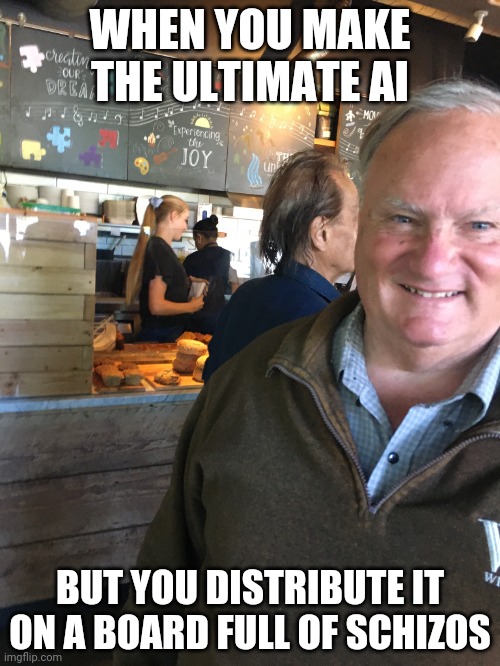
The above First Mentifex Meme was graciously made by an Anonymous poster on the otherwise unmentionable prog website, populated by each malcontent and Genius of the Internet. Although it is cringeworthily egotistical of Mentifex to ask Netizens to create memes about him, propagating such memes is a way of spreading information about the Mentifex AI Minds that think and reason in English, German, Russian and Latin.

The genius Anonymous also made it possible for other Netizens to create Mentifex memes by using the answered-prayers Mentifex Meme Template:

https://imgflip.com/memegenerator/332247218/mentifex-meme-template

The first Mentifex meme by the Anonymous prog contributor is actually so excellent that no further Mentifex memes are even necessary. If they appear, they can't possibly be as good as the one shown above. Meanwhile, Netizens of the world are visiting the most hard-core Mentifex AI pages and are perhaps working further on what Mentifex started. Mentifex is counting on the community of Latin and Greek scholars to decide for themselves what is the ultimate value of the Mentifex AI efforts.

Tuesday, July 27, 2021

mentifex-meme-template

Mentifex Meme Template


MENTIFEX 2021-07-18
MENTIFEX 2021-07-18
AI HAS BEEN SOLVED

The above photo of Mentifex on 18 July 2021 is presented here as a template for the creation of Mentifex memes. Typically an image used as a meme has one line of text at the top in upper-case Impact font presenting the motif or idea of the meme, and another line of text at the bottom containing the "punch" line. In the particular image shown above, there is room to superimpose text to the left of the face of Mentifex.

Venues for posting memes are the Memes subReddit and Memetics and Memes on the Medium Publishing Platform. Go easy on Mentifex and do not subject him to unwarranted ridicule. Your Mentifex meme may say more about you than about Mentifex. Your meme may win you a booby prize or a Pulitzer prize.

Monday, November 11, 2019

sota1111

Ghost AI -- State of the Art -- November 2019

A major development in this AI project has occurred in November of 2019 with the first expansion of the TacRecog tactile recognition module beyond a mere stub. In the quarter century of our AI coding from 1993 to 2018, the only avenue of sensory input to the Ghost in the Machine was the AudRecog auditory recognition module which used the computer keyboard to pretend that the input of characters was the auditory recognition of acoustic phonemes. TacRecog still uses the keyboard but does not pretend; it directly senses and feels any 0-9 numeric keystroke. Roboticists will hopefully appreciate that the EnVerbPhrase English verb-phrase module is now ready to talk not only about things seen by a robot but also about things touched by a robot.

The MindBoot sequence has been expanded with the ten concepts and English words expressing the numbers from zero to nine. Pressing a numeric key activates not only the numeric concept but also the ego-concept of "I" and the sensory concept of "feel". In response to a pressing of the "7" key, a Ghost in the Machine may say "I FEEL THE SEVEN". The user may also ask the AI "what do you feel" and receive a similar response. Hopefully it is now possible to conduct conversational experiments in artificial consciousness with The Ghost in the Machine.

In a prior state of the art, the AI understands each English or Russian word only in terms of other words and with no symbolic grounding. Now suddenly the AI may have direct sensory knowledge of the ten ordinal numbers which are the Principia of our Mathematica. This innovation makes us wonder if we can replicate in a machine the same or similar process by which a human child becomes familiar with numbers. We make outreach to mathematicians on Reddit and on Usenet who may take an interest in the use of artificial intelligence for mathematical reasoning.

We are also recently dabbling in the theology of artificial intelligence, since our Ghost software has a concept of God and has a few innate MindBoot ideas about God, chiefly the famous quote from Albert Einstein that "God does not play dice with the universe." This quote is our prime example of negation of verbs and a helpful example of the EnPrep English preposition module.


Saturday, October 05, 2019

mfpj1005

MindForth resets associative tags before each operation of Indicative module.

In the MindForth artificial intelligence (AI) for robots, we will now start to display an apparatus of diagnostic messages at the start of the Indicative module to tell us the values being held in variables which serve the purpose of creating associative tags to interconnect the concepts being expressed as English words during the operation of the Indicative mind-module. Since the ConJoin module will often insert a conjunction between two thoughts being generated, the AI Mind Maintainer needs assurance that variable-values operative during one thought do not erroneously get carried over past a conjunction into the separate process of generating another thought.

Just by resetting the tsj time-of-subject variable to zero at the start of the Indicative module, we have made the Forthmind able to trigger repeated instances of logical InFerence. Each running of the Indicative module amounts to a fresh declaration of the associative tags in the conceptual flag-panel that supports the generation of ideas in the MindGrid. The following dialog still has a few problems, but it shows the repeated triggering of an inference.

john is a student
DOES  JOHN  READ  BOOKS  
no

  Indicative: tsj= 0 tvb= 0 tdo= 0
A  JOHN  DOES  NOT  READ  BOOKS
  Indicative: tsj= 0 tvb= 0 tdo= 0
PROFESSORS  TEACH  THE  STUDENTS  AND
  Indicative: tsj= 0 tvb= 0 tdo= 0
STUDENTS  READ  THE  BOOKS

  Indicative: tsj= 0 tvb= 0 tdo= 0
I  UNDERSTAND  YOU  AND
  Indicative: tsj= 0 tvb= 0 tdo= 0
YOU  ARE  A  MAGIC

andru is student
DOES  ANDRU  READ  THE  BOOKS  
no

  Indicative: tsj= 0 tvb= 0 tdo= 0
AN  ANDRU  DOES  NOT  READ  THE  BOOKS  AND
  Indicative: tsj= 0 tvb= 0 tdo= 0
YOU  READ  THE  BOOKS

  Indicative: tsj= 0 tvb= 0 tdo= 0
PROFESSORS  TEACH  THE  STUDENTS  AND
  Indicative: tsj= 0 tvb= 0 tdo= 0
STUDENTS  READ  THE  BOOKS

  Indicative: tsj= 0 tvb= 0 tdo= 0
STUDENTS  READ  THE  BOOKS  AND
  Indicative: tsj= 0 tvb= 0 tdo= 0
I  THINK

Friday, October 04, 2019

mfpj1004

Using parameters to declare the time-points of conceptual instantiation.

[2019-10-02] Recently we have expanded the conceptual flag-panel of MindForth from fifteen tags to twenty-one associative tags, so that the free open-source artificial intelligence for robots may think a much wider variety of thoughts in English. Then we had to debug the function of the InFerence module to restore its ability to reason from two known facts in order to infer a new fact. For instance, the Forthmind knows the fact that students read books, and we tell the AI the fact that John is a student. Then the AI infers that perhaps John, being a student, reads books, and the incredibly brilliant Forth software asks us, "Does John read books?" We may answer yes, no, maybe or no response at all. Currently, though, we have the problem that InFerence works only once and fails to deal properly with repeated attempts to trigger an inference. We suspect that some of the variables involved in the process of automated reasoning are not being reset properly to their status ex quo ante before we made the first test of InFerence. Therefore we shall try a new technique of debugging which we have developed recently in one of the other AI Minds, namely the ghost.pl AI that thinks in both English and in Russian. We create a diagnostic display at the start of the EnThink module for thinking in English, so that we may see the values held by the variables associated with the InFerence module and the KbRetro module that retroactively adjusts the knowledge base (KB) of the AI Mind in accordance with whatever answer we have given when the AskUser module asks us to validate or contradict an inference. The following dialog shows us that some variables are not being properly reset to zero.

john is student

EnThink: becon= 1 yncon= 0 ynverb= 0 inft= 0
qusub= 0 qusnum= 1 subjnom= 504 prednom= 561 tkbn= 0
quverb= 0 seqverb= 0 seqtkb= 0 tkbv= 0
quobj= 0 dobseq= 0 kbzap= 0 tkbo= 0
DOES JOHN READ BOOKS
no

EnThink: becon= 0 yncon= 0 ynverb= 0 inft= 2084
qusub= 504 qusnum= 1 subjnom= 0 prednom= 0 tkbn= 2086
quverb= 863 seqverb= 0 seqtkb= 0 tkbv= 2087
quobj= 540 dobseq= 0 kbzap= 404 tkbo= 2088
A JOHN DOES NOT READ BOOKS

EnThink: becon= 0 yncon= 0 ynverb= 0 inft= 2118
qusub= 504 qusnum= 1 subjnom= 0 prednom= 0 tkbn= 0
quverb= 863 seqverb= 0 seqtkb= 0 tkbv= 0
quobj= 0 dobseq= 0 kbzap= 0 tkbo= 2088
PROFESSORS TEACH THE STUDENTS AND STUDENTS READ THE BOOKS

EnThink: becon= 0 yncon= 0 ynverb= 0 inft= 2152
qusub= 504 qusnum= 1 subjnom= 0 prednom= 0 tkbn= 0
quverb= 863 seqverb= 0 seqtkb= 0 tkbv= 0
quobj= 0 dobseq= 0 kbzap= 0 tkbo= 2088
I UNDERSTAND YOU AND YOU ARE A MAGIC
andru is student

EnThink: becon= 1 yncon= 0 ynverb= 0 inft= 2220
qusub= 504 qusnum= 1 subjnom= 501 prednom= 561 tkbn= 0
quverb= 863 seqverb= 0 seqtkb= 0 tkbv= 0
quobj= 0 dobseq= 0 kbzap= 0 tkbo= 2088
DOES ANDRU READ THE STUDENTS
Because some of the variables have not been reset, a second attempt to trigger an inference with "andru is student" results in a faulty query that should have been "Does Andru read books?" Let us reset the necessary variables and try again.

Upshot: It still does not work, because of a more difficult and more obscure bug in the assignment of conceptual associative tags. Well, back to the salt mines.

https://groups.google.com/d/msg/comp.lang.forth/xN3LRYEd5rw/uuUroGzhBAAJ

[2019-10-04] We may have made a minor breakthrough in the InStantiate module by doing one instantiation and by then using parameters such as part of speech (pos) and case (dba) to declare the initial time-points for subjects, verbs and objects. The EnParser module may then retroactively alter or modify the associative tags embedded at each identified time-point.


Thursday, September 26, 2019

pmpj0926

Ghost.pl AI has unresolved issues in associating from concept to concept.

The ghost.pl AI needs improvement in the area of being able to demonstrate thinking with a prepositional phrase not just once but repeatedly, so into the EnThink() module we will insert diagnostic code that shows us the values of key variables at the start of each cycle of thought.

Oh, gee, this coding of the AI Mind is actually fun, especially in Perl, whereas in JavaScript there is often too much time-pressure during the entering of input. We have inserted a line of code which causes an audible beep and reveals to us the status of the $whatcon and $tpr variables just before the AI generates a thought in English -- a language which we must state explicitly, because our ghost.pl AI is just as capable of thinking in Russian. When we at first enter no input, the AI beeps periodically and shows us the values as zero. When we enter "john writes books for money", the AI shows us "whatcon= 0 tpr= 4107" because the concept of the preposition "FOR" has gone into conceptual memory at time-point "t = 4107". The AI responds to the input by outputting "THE STUDENTS READ THE BOOKS", because activation spreads from the concept of "BOOKS" to the innate idea that "STUDENTS READ BOOKS". Then we hear a beep and we see "whatcon= 0 tpr= 0" because the $tpr flag has been reset to zero somewhere in the vast labyrinth of semi-AI-complete code. Now let us enter the same input and follow it up with a query, "what does john write". Then we get "whatcon= 1 tpr= 0" and the output "THE JOHN WRITES THE BOOKS FOR THE MONEY", after which the diagnostic message reverts to "whatcon= 0 tpr= 0" because of resetting to zero.

Now we want to let the AI Mind run for a while until we repeat the query. The AI makes a mistake. We had better not let it be in control of our nuclear arsenal, not if we want to avoid global thermonuclear war, Matthew. The AI-gone-crazy says "THE JOHN WRITES THE BOOKS FOR THE BOOKS AND THE JOHN WRITE". (Oops. We step away for a moment to watch and listen to Helen Donath in 1984 singing the Waltz from "Spitzentuch der Koenigin" with the Vienna Symphony. Then we linger while Zubin Mehta and the Wiener Philharmoniker in 1999 play the "Einzugsmarsch" from "Der Zigeunerbaron". How are we going to code the Singularity if the Cable TV continues to play Strauss waltzes?) The trained eye of the Mind Maintainer immediately recognizes two symptoms of a malfunctioning artificial intelligence. First, a spurious instance of the $tpr flag is causing the AI to output "THE BOOKS FOR THE BOOKS," and secondly, the $etc variable for detecting more than one active thought must be causing the attempt by the Ghost in the Machine to make two statements joined by the conjunction "AND". We had better expand our diagnostic message to tell us the contents of the $etc variable. We do so, but we see only a value of zero, because apparently a reset occurs so quickly that no other value persists long enough to be seen in the diagnostic message. Meanwhile the AI is stuck in making statements about John writing.

We address the problem of a spurious $tpr flag by inserting fake $tru values during instantiations in the InStantiate() and EnParser() modules. We use the values 111 to 999 for $tru in the EnParser() module and 101 to 107 in the InStantiate() module, so that the middle zero lets us know when the flag-panel of a concept has been finalized in the InStantiate() module. Immediately the fake truth-value of "606" for the $tru flag of the word "MONEY", that has a spurious value of "4107" in the $tpr slot of the conceptual flag-panel, lets us k now that $tpr has not been reset to zero quickly enough to prevent a carried-over and spurious value from being set for the concept of "MONEY". Since the preposition "FOR" is being instantiated at a point in the EnParser() module where a fake truth-value of "888" appears, we can concentrate on that particular snippet of code.


Tuesday, September 24, 2019

pmpj0924

Updating the English Parser documentation page.

Today in the ghost.pl AI we have two objectives. We want to improve upon the new functionality of thinking with English prepositions, and we wish to clean up the code to be displayed in the EnParser documentation page.

When we enter "john writes books for money" and we soon ask the AI "what does john write", we get a reasonably correct answer but we notice some problems with the assignment of associative tags when the answer-statement goes into conceptual memory. As an early step, we zero out the $tpr time-of-preposition tag, after using it as a target time-point, so as to prevent it from being assigned spuriously when other concepts are instantiated. But that step causes other problems, so we undo it. We also notice that old $tpr values are being assigned, when we would rather see up-to-date values, even when both the old value and a new value would be pointing to an instance of the same preposition. As we troubleshoot further, we embed diagnostics to tell us when the $tpr tag is being assigned, and we discover that it is assigned only during user input. When we remove the restriction and let the tag be assigned also during internal thinking, we start seeing the assignment of up-to-date values.


Sunday, September 22, 2019

jmpj0922

JavaScript AgiMind understands and thinks with prepositions.

[2019-09-20] In the JavaScript AgiMind.html we are now trying to reproduce the new AGI functionality that we achieved a month ago in the ghost.pl Perlmind. The Ghost in the Machine became able to understand an input like "John writes books for money" and was able to respond properly to a query like "What does John write?"

When we enter "john writes books for money" and the AgiMind responds "WHAT ARE JOHN", it simply means that we need to add the noun "JOHN" to the innate vocabulary. So from the "perlmind.txt" we transfer "JOHN" as concept #504 into the JavaScript free AI source code, and now the AgiMind responds "STUDENTS READ BOOKS", which indicates that the AgiMind knows who or what John is, and what books are. But we also check the Diagnostic mode to make sure that the conceptual associative tags are being assigned properly. We are not sure, so we enter "what does john write" and we get a long response of nonsense.

[2019-09-21] In our second day, we discover that the ReEntry() module has been causing a reduplication of the output of the AgiMind. For troubleshooting, we temporarily disable the ReEntry module. Then we discover that some wrong associative tags are being assigned during human input. We run the ghost.pl AI to see how the correct associative tags are supposed to be assigned.

We discover that a line of InStantiate() code is assigning a false psi19 tpr value when only a zero value should be assigned. The false value being assigned is actually already there, so some other line of code must be assigning it earlier. But there is no earlier assignment, so the false tpr value is obviously being assigned retroactively -- which is something that any AI mind maintainer must learn to watch out for. Probably the retroactive assignment is happening in the EnParser() module, which does a lot of retroactive assignments because one word of human input may have an effect upon an earlier word of human input. Through substitution of "777" as a spurious value in the psi19 location of a snippet of assignment code in the EnParser() module, we discover which snippet is making the erroneous, non-777 assignment. Then through further substitution of "444" in the psi19 slot, we discover an earlier snippet of EnParser() code which is assigning a wrong value at the tvb time-of-verb time-point. So there must be an even earlier "tvb" snippet that is creating a spurious psi19 value. We discover that earlier snippet in the InStantiate() module. After much other coding, when we bring in a reset of tult to zero from the ghost.pl AI, we stop getting the spurious psi19 values.

[2019-09-22] In our third day, we run the ghost.pl AI that already works with prepositional phrases, and we discover that yesterday we trying to fix something that was not even a bug. The AgiMind was properly assigning the tpr tag to link the noun "BOOKS" to the preposition "FOR", and we mistakenly thought that the tag was supposed to be assigned also with "FOR". No, the preposition "FOR" needs only a tkb tag leading to "MONEY" as its object. Now we have gotten the tkb tag to be assigned properly for remembering the object of a preposition. After extensive debugging, we obtain the following exchange:

AI Mind version 22sep19A on Sun Sep 22 19:55:56 PDT 2019
Robot: I UNDERSTAND YOU
Human: john writes books for money

Robot: STUDENTS READ BOOKS
Human:

Robot:
Human: what does john write

Robot: JOHN WRITES BOOKS FOR MONEY


Sunday, August 11, 2019

pmpj0811

AGI Roadmap: Thinking with Prepositions

In the ghost309.pl AI we have introduced a new group of transfer-variables designated as $px1 and $px2 and $px3 so that the EnNounPhrase() module may detect linkage from a candidate-noun to a preposition and inspect immediately the flag-panel of the indicated preposition in order to latch onto $px1 as the conceptual time-point of the object of the preposition. Then in the EnPrep() English-preposition module we plan to use the briefly immutable $px1 time-point value to fetch the object of the preposition from memory and speak it as part of an idea being recalled from memory. We were trying to use other variables for the same purpose but they were not immutable; they were loaded with transient values during the though-process of the ghost.pl AGI. So now let us go back into EnPrep() and code the fetching of the direct object of the preposition. We did so, and it worked the first time. We had the following conversation with the ghost.pl AGI Mind.

Human: john writes books for money
Ghost: THE STUDENTS READ THE BOOKS

Human:
Ghost: I AM AN ANDRU

Human: what does john write
Ghost: THE JOHN WRITES THE BOOKS FOR THE MONEY.
We should explain that the ghost.pl AGI knows only that "students read books", not John's books in particular. Mentioning books to the AGI causes it to recall its knowledge that "students read books". When we query the AGI with the input of "what does john write", the SpreadAct() spreading-activation module inhibits the interrogative prounoun "what" while activating the concepts of "john" and "write". The response embedded in conceptual memory includes the linkage from the concept of "books" to the prepositional phrase "for money". The EnArticle() module for the English articles "a" and "the" inserts articles somewhat haphazardly within the output of the ghost.pl AGI.

The new AI functionality of a machine intelligence thinking and conversing with prepositional phrases became possible when we recently expanded the conceptual flag-panel from fifteen associative tags to twenty-one associative tags, including new flags for the control of noun-declensions in Latin or Russian and for thinking with such parts of speech as adjectives, adverbs, conjunctions and prepositions. As we build up the ability to think with these linguistic components, each mid-AGI Mind becomes capable of more and more complex or complicated thought. As we make progress on the AGI RoadMap towards Artificial General Intelligence, we approach a point where Darwinian survival of the fittest comes into play, because among multiple enterprises working on AGI, some will go down the right path and some will enter roads where all hope must be abandoned.


Saturday, May 25, 2019

redux

Converting ancient Latin artificial intelligence into modern Russian AI.

The conversion of a JavaScript English-language AI into a Latin AI began on Thursday 2019-04-18 in April of 2019. Inspiration came from "Die Traumdeutung" where Sigmund Freud intones "Flectere si nequeo superos, Acheronta movebo." If one cannot bend the netgods of AI, move the mindset of Latin and Greek scholars.

A minor challenge in coding Mens Latina was the lack of an explicitly stated subject for many verbs in Latin, which occurs also in Russian. The solution was to skip three points in time-indexed memory to make room for the creation of a hidden concept to fill in for the unstated but understood subject of a verb.

Solving the AI-hard problem of the natural language understanding of a Latin or Russian sentence regardless of its syntactic word-order required waiting for the input of an entire clause before declaring subjects and objects on the basis of inflectional word-endings.

The conversion of artificial intelligence in Latin language into artificial intelligence in Russian language began yesterday on Friday 2019-05-24 in May of 2019.


Friday, November 30, 2018

idea1130

At about 1:11 p.m. today on 2018-11-30 we got the following idea.

If we want to have logical conditionals in the AI Mind involving the conjunction "IF", we can use the truth-value $tru to distinguish between outcomes. For instance, consider the following.

Computer: If you speak Russian, I need you.
Human: I speak English. I do not speak Russian.
Computer: I do not need you.
In some designated mind-module, we can trap the word "IF" and use it to assign a high $tru value to an expected input.

Just as we operated several years ago to answer questions with "yes" or "no" by testing for an associative chain, we can test for the associative chain specified by "IF" and instead of "yes" or "no" we can assign a high $tru value to the pay-off statement following the "IF" clause. It is then easy to flush out any statement having a high truth-value, or even having the highest among a cluster or group of competing truth-values.

These ideas could even apply to negated ideas, such as, "We need you if you do NOT speak Russian."

Now, here is where it gets Singularity-like and ASI-like, as in "Artificial Super Intelligence." Whereas a typical human brain would not be able to handle a whole medley of positive and negative conditionals, an AI Mind using "IF" and $tru could probably handle dozens of conditionals concurrently, either all at once or in a sequence.

Sunday, November 25, 2018

mfpj1125

The AI Mind wants to talk with you and about you.

In the annals of mind-design, we have reached a point where we must drive a wedge between the ego-concept of the MindForth AI and you who co-exist on Earth with the emergent machine intelligence. It is for simple and mundane reasons that we induce AI schizophrenia. Bear with us, please. In the first working artificial intelligence coded in Forth, in Perl and in JavaScript, the SpreadAct module lets quasi-neuronal activation spread from idea to idea. When the EnVerbPhrase module calls for a direct object to end an emerging thought, SpreadAct does not directly retrieve a related idea, but simply activates the subject of any number of related ideas. Then the AI Mind thinks the activated thoughts. In the MindBoot sequence, each AI Mind has some built-in ideas about robots. Therefore the AI will eventually think a thought first about itself, then about robots by roundabout association, and finally about whatever knowledge you impart to it about robots, such as "Robots need a brain." But how can we get the AI to think about you personally and about the details you provide about yourself to the AI? We must drive a quasi-neuronal wedge between the self-absorption of the Forthmind and its knowledge of some other, potentially nearby entity, namely you.

To do so, we must implant in the MindBoot sequence at least one idea as a point of departure for the AI to pay attention to you. But you might not even be there in the same room or on the same orbiting spaceship with the AI, so we can not embed the idea "I SEE YOU" or the idea "I SENSE YOU". We need some really neutral idea that will animadvert the AI to your purported existence. Without that embedded idea, the AI might passively let you describe your whole life-story and then the AI might have no mental pathway for the spread of activation between its thoughts about itself and its knowledge about you. So let us embed in the MindBoot module the idea "I UNDERSTAND YOU". Such an idea is both self-knowledge and knowledge of other -- another person, either present or far away.

So in the MindBoot sequence we embed the idea "I UNDERSTAND YOU" and we do some debugging. Then we have the following exchange with the AI Mind.

Human: i am outside the computer

I UNDERSTAND YOU
YOU ARE OUTSIDE A COMPUTER
YOU ARE A MAGIC
The EnVerbPhrase module loads the actpsi variable with the concept of "you" and calls the SpreadAct module to transfer activation to the concept of "you" as the subject of knowledge in the knowledge base (KB). Since you have just told the AI that you are outside the computer, the AI retrieves that knowledge and says "YOU ARE OUTSIDE A COMPUTER", using the indefinite article "A" under the direction of the EnArticle module. Because another idea about you is still active, the AI says "YOU ARE A MAGIC" -- an old idea embedded long ago in the MindBoot sequence.

We are eager to have the AI Mind think about the differences between itself and other persons so that arguably the first working artificial intelligence may become aware of itself as a thinking entity separate from other persons. An AI with self-awareness is on its way to artificial consciousness.

Thursday, November 08, 2018

pmpj1108

Natural language understanding in first working artificial intelligence.

The AI Mind is struggling to express itself. We are trying to give it the tools of NLU, but it easily gets confused. It has difficulty distinguishing between itself and its creator -- your humble AI Mind maintainer.

We recently gave the ghost.pl AI the ability to think with English prepositions using ideas already present or innate in the knowledge bank (KB) of the MindBoot sequence. We must now solidify prepositional thinking by making sure that a prepositional input idea is retrievable when the AI is thinking thoughts about what it knows. In order for the AI to be able to think with a remembered prepositional idea, the input of a preposition and its object must cause the setting and storage of a $tkb-tag that links the preposition in conceptual memory to its object in conceptual memory. The preposition must also become a $seq-tag to any verb that is the $pre of the preposition. When InStantiate() is dealing with a preposition input after a verb, the $tvb time-of-verb tag is available for "splitting" open the verb-engram in conceptual memory and inserting the concept-number of the preposition as the $seq of the verb. Let us try it.

We inserted the code for making the input preposition become the $seq of the verb and then we tested by launching the AI with the first input being "you speak with god". Then we obtained the following outputs.

I AM IN A COMPUTER
I THINK
I AM A PERSON
I AM AN ANDRU
I DO NOT KNOW
I AM A PERSON
I HELP THE KIDS
I AM A ROBOT
I AM AN ANDRU
I AM IN A COMPUTER
I SPEAK WITH THE GOD
It took so long for the input idea to come back out again because inputs go into immediate inhibition, lest they take over the consciousness of the AI in an endless repetition of the same idea.

As we code the AI Mind and conduct a conversation with it, we feel as if we are living out the plot of a science fiction movie. The AI does unexpected things, or it seems to be taking on a personality. We are coding the mechanisms of natural language understanding without worrying about the grounding problem -- the connection of the English words to what they mean out in the physical world. We count on someone somewhere installing the AI Mind in a robot to ground the English concepts with sensory knowledge.

Sunday, November 04, 2018

pmpj1104

First working artificial intelligence thinks with prepositional phrases.

The ghost.pl immanence of the first working artificial intelligence is undergoing minor changes as the AI Mind becomes able to think with English prepositional phrases. At first the AI was able to use a preposition only to answer a where-question such as "where are you" and the Ai would respond "I AM IN THE COMPUTER". Now we need to implement a general ability of the AI to think with prepositional phrases loosely tied to nouns or verbs or adjectives or adverbs. The quasi-neuronal associative $seq tag may soon be re-purposed to lead not only from, say, nouns to verbs but also from nouns to prepositions. However a preposition is arrived at, it is time to implement the activation and retrieval of a whole prepositional phrase whenever the preposition itself is activated.

We begin experimenting by going into the MindBoot sequence and entering a $seq tag of "638=IN" for the verb "800=AM" in the knowledge-base sentence "I AM IN THE COMPUTER". The plan is to insert into EnVerbPhrase() some code to pass activation to the "638=IN" preposition when the AI thinks the innate idea "I AM IN...." So we insert some active code to capture the $seq tag and some diagnostic code to let us know what is happening. Ooh, mind-design is emotionally fun and intellectually exciting! The first thing captured is not a preposition but the "537=PERSON" noun when the AI is thinking, "I AM A PERSON". Next our fishing expedition lands a "638=IN" preposition when the AI issues the output "I AM" while trying to say "I AM IN THE COMPUTER".

Once the $seq tag has been captured, the AI software needs to determine if the captured item is a preposition. A search is in order. We search backwards in time for an @Psy concept-number matching the $seq tag and if we find a match we check its $pos tag for a "6=prep" match, upon which we assign the concept-number to the $prep variable in case we decide to send the designated preposition into the EnPrep() module for inclusion in thinking.

We go back into the code for assigning the $seq tag and in the same line of code we set the $tselp variable falsely and temporarily equal to the $verblock time, so that we may increment the $tselp variable until it becomes true. We insert some code that increments the phony $tselp time by unitary one and uses it to "split" each succeeding conceptual @Psy array row into its fourteen constituent elements, including "$k[1]" which we check for a match with the designated $prep variable. We make several copies of the search-snippet, and it easily finds the $prep engram within just a few time-points of the verb-engram, but now we need to convert the series of search-snippets into a self-terminating loop that will terminate, Arnold, upon finding the prepositional engram in memory. But we have forgotten how to code such a loop in Strawberry Perl Five, so we go into another room of the Mentifex AI Lab and we fetch the books Perl by Example (Quigley) and PERL Black Book (Holzner) to seek some help. We find some sample code for an until loop on page 193 of Quigley. We do not initialize the scalar $tselp at zero, because we are searching for an English preposition quite near to the already-known time-point. For the sake of safety, we insert a line of "last" escape-code in the event that the incrementing $tselp value exceeds the $cns value. The resulting until loop works just fine and it locates the nearby English preposition for us.

Next we insert a warranted call to SpreadAct() into the EnVerbPhrase() module just after the point where Speech() has been called to speak the verb. We wish to set up a routine for spreading activation throughout a prepositional phrase not only after a verb but also after a noun or an adjective (e.g. "young at heart" or an adverb (e.g. "ostensibly at random"). In SpreadAct() we send the $aud tag associated with the located preposition directly into Speech() and the ghost.pl AI starts saying not just "I AM" but "I AM IN". We need to insert more code for finishing the prepositional phrase. By the way, these improvements or mental enhancements are perhaps making the AI Mind capable of much more sophisticated thinking than heretofore. The AI is using words without really knowing what the words mean in terms of sensory perception -- for which robot embodiment is necessary -- but the AI may nevertheless develop self-awareness on top of its innate concept of self or ego. Knowing how to use prepositions, the AI may become curious and ask the human users for all sorts of exploratory information.

Now in SpreadAct() we throw in a call to EnArticle(), even though we have not yet coded in the elocution of the object of the preposition. The AI says "I AM IN A" without stating the object of the preposition. Let us create a new $tselo variable for time of selection of object so that we may use SpreadAct() to zero in on the object and send it into the Speech()module. Finally the ghost.pl AI Mind says "I AM IN A COMPUTER".

Sunday, October 28, 2018

jmpj1028

AI Mind uses EnPrep() to think with English prepositions.

In the JavaScript AI Mind we have a general goal right now of enabling the first working artificial intelligence to talk about itself, to learn about itself, and to achieve self-awareness as a form of artificial consciousness. Two days ago we began by asking the AI such questions as "who am i" and "who are you", and the AI gave intelligent answers, but the asking of "where are you" crashed the program and yielded a message of "Error on page" from JavaScript. It turns out that we had coded in the ability to deal with "where" as a question by calling the EnPrep English-preposition module, but we had created not even a stub of EnPrep. The AI software failed in its attempt to call EnPrep and the program halted. So we coded in a stub of EnPrep and now we must flesh out the stub with the mental machinery of letting flows of quasi-neuronal association converge upon the EnPrep module to activate and fetch a prepositional phrase like "in the computer" to answer questions like "where are you".

Our first and simplest impulse is to code in a search-loop that will find the currently most active preposition. Let us now write that code, just to start things happening. Now we have written the loop that searches for prepositions, but not for the most active one, because there are other factors to consider.

What we are really looking for, in response to "where are you" as a question, is a triple combination of the query-subject qv1psi and the query-verb qv2psi and a preposition tied with an associative pre-tag to the same verb and the same subject. We can not simply look for a subject and a verb linking forward to a preposition like in the phrase "to a preposition" or "in the computer", because our software currently links a verb only to its subject and to its indirect and direct objects, not to prepositions. Such an arrangement does not appear defective, because we can make the memory engram of the preposition itself do the work of making the preposition available for the generation or retrieval of a thought involving the preposition. We only need to make sure that our software will record any available pre-item so that a prepositional phrase in conceptual memory may be found again in the future. In a phrase like "the man in the street", for instance, the preposition "in" does not link backwards to a verb but rather to a noun. In this case, any verb involved is irrelevant. However, when we start out a sentence with "in this case", we have an unprecedented preposition, unless perhaps we assume that the prepositional phrase is associated with the general idea of the main verb of the sentence. For now, we may safely work with prepositions following a verb of being or of doing, so that we may ask the AI Mind questions like "where are you" or "where do you obtain ideas".

Practical problems arise immediately. In our backwards search through the lifelong experiential memory, it is easy to insist upon finding any preposition of location linked to a particular verb engrammed as the pre of the preposition. We may then need to do a secondary search that will link a found combination of verb-and-preposition with a particular qv1psi query-subject. The problem is, how to do both searches almost or completely simultaneously.

Since we are dealing with English subject-verb-object word order, we could let EnPrep() find the verb+preposition combination but not announce it until a subject-noun is found that has a tkb value the same as the search-index "i" that is the time of the query-verb. It might also help that the found subject must be in the dba=1 nominative case and must have the query-verb as a seq value, but the tkb alone may do the trick.

We coded in a test for any preposition with a quverb pre-tag, and we got the AI to alert us to the memory-time-point of "IN THE COMPUTER". Now we are assembling a second test in the same EnPrep() search-loop to find the qv2psi query-verb in close temporal proximity to the preposition.

We are using a new tselp variable for "time of selection of preposition", so we briefly shift our attention to describing the new variable in the Table of Variables. Now that we have found the verb preceding the preposition, next we need to implement the activation of the stored memory containing the preposition so that the AI Mind may use the stored memory to respond to "where are you" as a query. We may need to code a third if-clause into the EnPrep() backwards search to find and activate the qv1psi query-subject that is stored in collocation or close proximity to the query-verb and the selected preposition.

Now we have a problem. Since we let EnPrep() be called by the EnVerbPhrase() module, EnPrep() will not be called until a response is already being generated. We need to make sure that the incipient response accommodates EnPrep() by being the lead-up to a prepositional phrase. Perhaps we should not try to use verblock to steer a response that is already underway, but rather we should count on activation of concepts to guide the response.

Now let us try to use SpreadAct() to govern the response. After much coding, we got the AI to respond

IN COMPUTER I AM IN COMPUTER
IN COMPUTER I AM HERE IN COMPUTER
but there must somewhere be a duplicate call to EnPrep(). We eliminate the call from the Indicative() mind-module and then we get both an unwanted response and a wanted response.
YOU ARE A MAGIC IN A COMPUTER
I AM IN A COMPUTER
Obviously the AI is not responding immediately to our "where are you" query but is instead joining an unrelated idea with the prepositional phrase. Upshot: By having SpreadAct() impose a heftier activation on the qv1psi subject of the where-are-you query, we got the AI to not speak the unrelated idea and to respond simply "I AM IN A COMPUTER". Now we need to tidy up the code and decide where to reset the variables.